
PRESS RELEASE: Scorching our schools
Smart Surfaces Coalition Identifies New Orleans’s Top Ten Hottest Schools and Schoolyards
〰️
Smart Surfaces Coalition Identifies New Orleans’s Top Ten Hottest Schools and Schoolyards 〰️
New Orleans, Oct. 14, 2026 -- Heat modeling of New Orleans has identified the top 10 hottest New Orleans schools and schoolyards, according to a new review by the non-profit Smart Surfaces Coalition. At all 10 schools, temperatures climb above 102°F during the hottest parts of the year, according to micrometeorological modeling. This extreme heat is disastrous for students’ health and academic performance, while putting after-school athletes’ lives at risk. However, common sense solutions citywide could cool neighborhoods around these New Orleans schools by up to 4.0°F, Smart Surfaces Coalition reveals in its new assessment.
Efforts to cool classrooms in New Orleans could not come at a better time. One of the summer’s hottest heat waves struck just as school started in the New Orleans metro area. Days into the new year at Alice Harte Charter School, as the outdoor heat index topped 115°F, AC units broke, forcing students to be sent home.
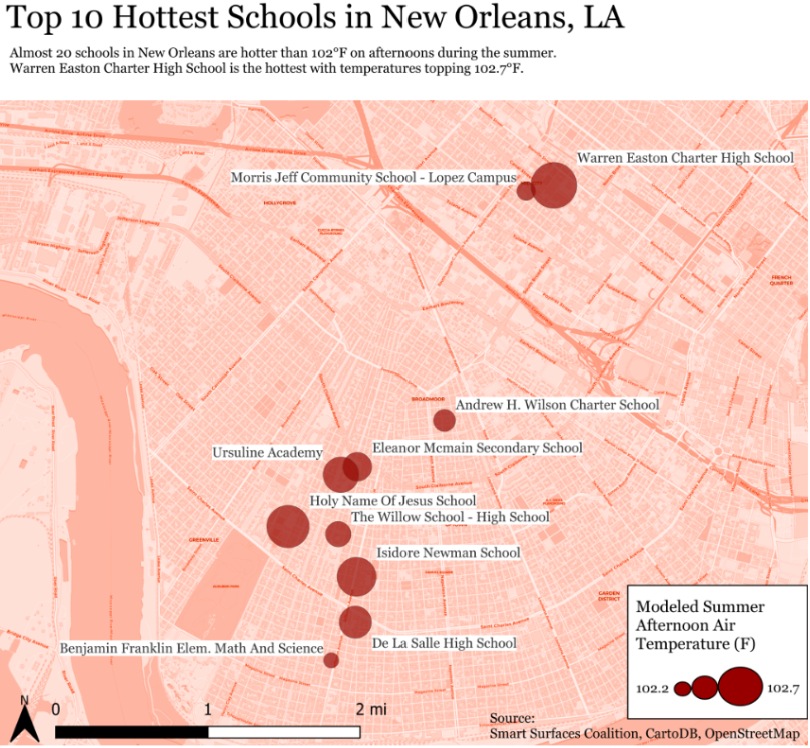
The review by Smart Surfaces Coalition, based on the organization’s new satellite mapping and micrometeorological modeling, identifies the Mid-City neighborhood around Warren Easton Charter High School as the hottest school in New Orleans. The neighborhood’s temperatures top 102.7°F on hot summer days, with heat warnings extending into back to school season. However, with the citywide adoption of policies and programs to add more urban trees, green stormwater infrastructure, cool roofs, permeable paving, and reflective pavement technologies, the neighborhoods near schools like Warren Easton can be up to 4.0°F cooler.
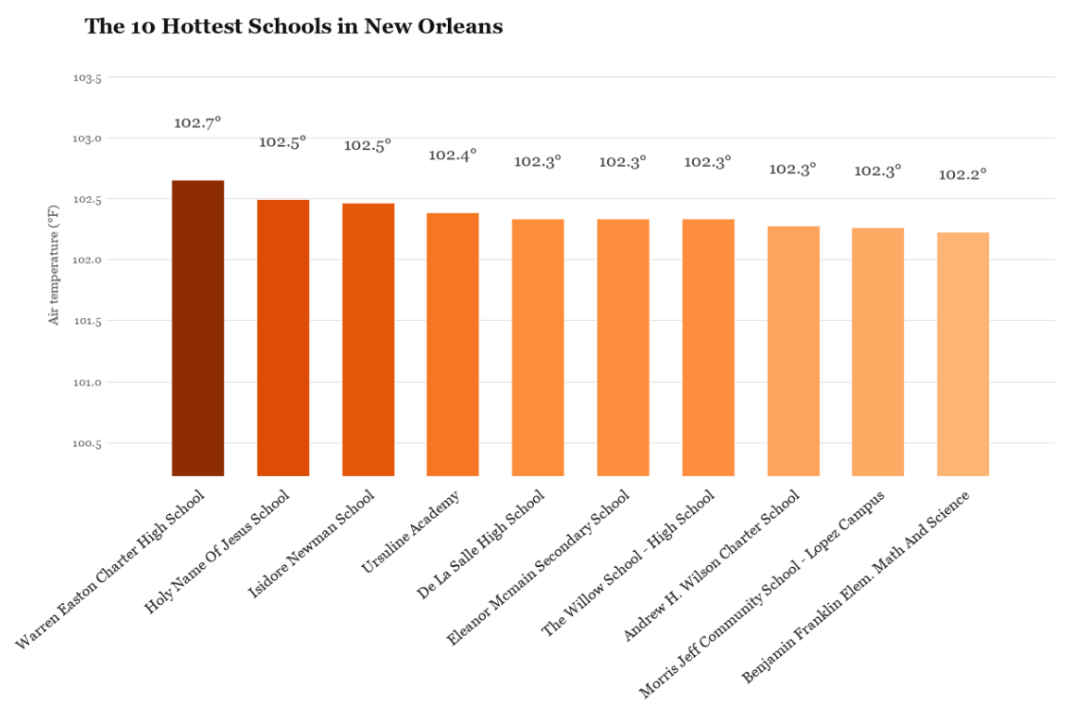
The top 10 hottest schools in New Orleans are:
Warren Easton Charter High School: 102.7°F
Holy Name of Jesus School: 102.5°F
Isidore Newman School: 102.5°F
Ursuline Academy: 102.4°F
De La Salle High School: 102.3°F
Eleanor McMain Secondary School: 102.3°F
The Willow School 9-12: 102.3°F
Wilson Charter School: 102.3°F
Morris Jeff Community School K-8: 102.3°F
Benjamin Franklin Elem. Math and Science School: 102.2°F
“Smart surfaces including shade trees, green stormwater infrastructure, reflective roofs and pavements, permeable paving and others can save lives,” said Greg Kats, CEO and founder of Smart Surfaces Coalition. “At a time of skyrocketing temperatures, these common sense fixes can protect New Orleans’s schoolchildren from dangerous heat inside classrooms and on their playgrounds.”
Citywide cooling has expansive health, economic, and environmental benefits, boosts academic performance, improves the health of outdoor athletes, and increases student attendance. A 1°F-hotter school year was associated with a 1% loss in learning in a study from the American Economic Journal. Students were 16% more likely to be absent on days when temperatures exceeded 90°F compared to temperatures in the 60s, according to a study of schools with broken or nonexistent air conditioning from Harvard University. After-school athletes are also dramatically affected by extreme heat, with more than 9,000 high school athletes treated for heat-related illnesses each year. Cooler temperatures will also help protect kids playing outside at recess.
Ten major US cities, including New Orleans, have partnered with Smart Surfaces Coalition (SSC) to make their infrastructure more resilient, sustainable, and cooler in the face of climate change. SSC research shows a total 25-year potential of $2.2 billion in electricity bill savings, $6.1 billion in public health benefits, and $11.3 billion in avoided infrastructure costs if those 10 partner cities continue to embrace additional policies to build out climate resilient infrastructure. SSC also modeled the potential impacts for more than 800 suburban cities and towns in the metro areas of the core cities, which would also see tens of billions of dollars in benefits from smart surface deployment.
The cities – Atlanta, Boston, Charlotte, Columbia (SC), Dallas, Jacksonville, New Orleans, Phoenix, Portland (OR), and San Antonio – are taking action. Some examples include a cool roof ordinance in Atlanta, projected to cool the city by 2.9°F, cut electricity bills by $310 million, and deliver over $450 million in public health benefits, improved green stormwater infrastructure policies in Boston, a Climate Bond Resolution in Dallas that ties climate mitigation and resilience requirements to the city's most recent $1.25 billion bond program, a Cool Neighborhoods Program in San Antonio, and over a dozen more plans and policies.
Smart Surfaces Coalition:
The Smart Surfaces Coalition is proud to partner with over 40 leading national and international organizations with a shared commitment to creating cooler, healthier, and more resilient cities by cost-effectively reducing the impacts of extreme urban heat and flooding. Smart Surfaces — reflective, porous, and green urban surfaces along with trees and solar PV — can cut peak summer temperatures by 5°F or more, decrease flood risk, slow climate change, and improve public health, with the greatest improvements in low-income neighborhoods and communities of color. smartsurfacescoalition.org
MEDIA CONTACT:
Jim Popkin, Seven Oaks Media Group
jim@sevenoaksmedia.com
202.253.7959